Thursday, January 14, 2016

Terrorrism: The Foolishly Ineffective Way to Get Your Point Across

At school today, I first heard about the news about the bombs that went off in Sarinah, Thamrin, Central Jakarta: In a police post and in front of a Starbucks Coffee store. Several people lost their lives, including several terrorists that got shot in the following firefight. This invited the attention from other nations worldwide, but that also means that Indonesia's economy might fall once more due to mistrust. 

Who did this foolish act, nobody knows for sure, however some state ISIL (Islamic State of Iraq and the Levant, also known as ISIS or Daesh) as the possible mastermind. What point they are trying to get across, nobody also know at this point. Now, if terrorism couldn't immediately deliver a message, even after sacrificing the lives of suicide bombers, then it has a flaw, ineffective.

Terrorism has no one definition all scholars, military men, and governments agree on, however a broad term able to at least give a clearer picture of what it is, is that terrorism is violence toward civilians not done by a state, to convey a political or ideological message. Using violence, possibly resulting in the deaths of the terrorist him/herself and innocent lives while the message itself isn't effectively delivered is, for certain, incredibly dumb. In this essay we'll stick to this broad term, and refer to the actors of terrorism as terrorists.

But just how effective is terrorism? While it does scare the public, and could make the standing government seem less credible in protecting its people if sequential acts occur, at the end, terrorism just makes the people wroth rather than surrendering, then directs the governmental and worldwide focus to the terrorists, at the end hampering the spread of the ideology itself.

First of all, everyone (perhaps, save for deranged men who love violence) will stir in anger if they find out that innocent lives have been lost, a truly immoral act. True, that the people living in the vicinity of the event (such as myself, who live in Jakarta) will be on high alert, perhaps scared. Repeated terrorism may scare the public enough to give pressure to a government to hand over concessions to the terrorists, but proud, nationalistic men will not stand for innocent lives being lost, would we? At the end, the terrorists will just face the wrath of the people, multiple calls for the root cause to be exterminated.

The people now will pressure the government to react, and then the entire world's eye will turn against the organization. Before long, many more will join the fight against the ideology. This happened in the aftermath of 9/11, after which the United States declared the war on terror. At the end, the same fate to the terrorists shall happen like the Al-Qaeda: their head lopped off.

That being said, the citizens are indeed still scared at the aftermath of the attack. Several investors flee, fearing for the safety of their money, which may lead to a crisis if this goes on. Shall we just cower in fear? Why should we submit to fear, the very thing that those terrorists want to instill? Should the trending hashtag be #prayforindonesia? I say not. #indonesiamustfight should be better. The government should and will protect the citizen, and we should go on with our lives, carefully. Indonesia already had went through much attempts at terrorism. We still stand proud.

At the end, the hashtag shall be #prayforterrorists, who all shall burn in their hell.

___
References. Read further about this in the following sites:
[1] Steinsson, Sverrir. 2014. Is Terrorism an Effective Way to Attain Political Goals?. Retrieved 6:28 PM, 14 January 2016, from http://www.e-ir.info/2014/06/22/is-terrorism-an-effective-way-to-attain-political-goals/
[2] Thomas, Jakana. 2014. Actually, Sometimes Terrorism Does Work. Retrieved 6:30 AM, 14 January 2016, from https://www.washingtonpost.com/news/monkey-cage/wp/2014/04/22/actually-sometimes-terrorism-does-work/
Various news sources, including BBC Indonesia, KompasAntara, and Viva News.

On further note, people usually associate terrorism with Islam, and Islam may have been tainted in the world by that. The fact that terrorism strikes in Indonesia, the largest Islamic nation, proves that it is not Islam that is the problem, but the people. Do not hate Islam, but fight the terrorists.

Wednesday, January 13, 2016

Akame ga Kill! - My Thoughts

Ah well, perhaps I'll be doing reviews on some of my most recently watched shows. I finished Akame ga Kill in about five days--just finished it today, in fact. So, like Noaragami, I'll be doing an overview. This is quite an older show (If one-plus years is old) so I won't really hold back on spoiling. And perhaps, this shall be a rant: maybe no structure whatsoever but to vent my thoughts.

Akame ga Kill started off quite nicely. Tatsumi is quite a nice character. However, we didn't get a good explanation of how he became better than the others. About the story. It was fine at the start, but goes on quite wildly to kill random, seemingly important characters who could perhaps be fleshed out better.

About the characters. Major spoilers ahead.
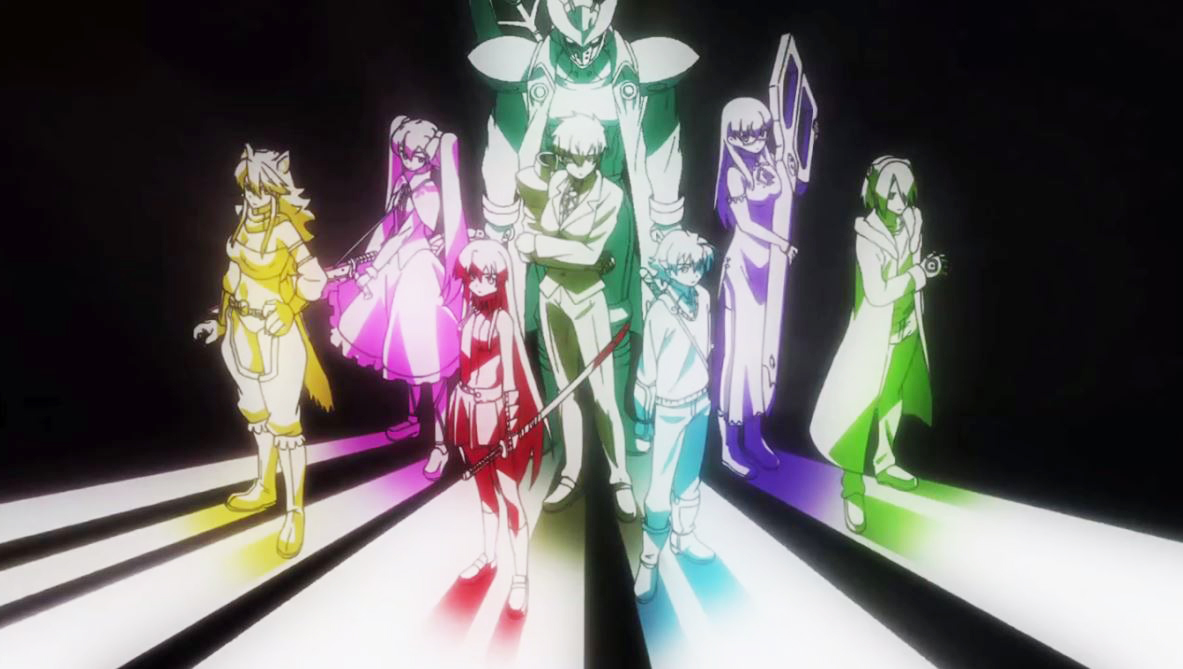
The first assassin group. Taken from the first opening.
Akame, perhaps the only one who Tatsumi won't defeat anytime soon. However, I didn't get why Akame betrayed her old assassin squad. The Capital should've completely mindwashed all of their subjects, have they not? Her sister, Kurome, should've been better as the Capital assassin. Perhaps that was why she wanted to kill Akame so badly.

Yeah, Akame looks cute and has great swordsmanship, I need to give that to the producers. However, for a show who has her name in its title, her character seems not completely fleshed out by the end of the show. Tatsumi got all the story. Well, that makes Akame ga Kill memorable: the main character who's a deuteragonist (that is, the second most important person in the story).

When I first watched the show, never expected it to become like Game of Thrones, with the gore and the major character deaths. Unpredictable, I quite like that. Shame, that unpredicableness wears off when you know that everyone shall die but Akame. Every single Night Raid member. Cool members, with at the very least enough story to make each death an emotional one, at the very least.

To recap: Sheele's death became the first stunning death, but that became quite the driving force for Mine. Bulat's was the only way of giving Incursio to Tatsumi (But must he use Incursio?).

Then they are replaced by Chelsea, who died usefully, weakening Kurome, and Susanoo, who fought bravely. Then, about Mine: that was just sad, not able to die beside her loved one. But why do we need to have this funny love triangle going on, again? Finally, Leone's death was quite sad, but not after epicly crushing the Minister's head.

But a lousy way to die for Tatsumi. He didn't even had the most memorable of final moments, passing away after  With a woman that loves him but doesn't love back: General Esdeath. I've no idea about love. An alien concept, at least for now. I have no idea where that love started for Esdeath. Fascinating conflict, though.

Oh yeah, Boss survived.

Now. The Jaegers could have been used much better to be the villains we also hate to die. And they succeeded, to a point. I just feel that they could be used better, at least waver upon realizing what the Empire has done.

Waver... reminds me of Wave. Did he die?

So, overall, decent characters. Just...decent. Most, if not all, of them, are perhaps too shallow, too one-sided. There should be more interesting conflict if they are better sculpted. Well, they're already experts in writing, aren't they? I shouldn't blame them too much.

More about the story, then. It ended quite abruptly. Why did they opt for the huge-mecha-villain end? Perhaps, out of ideas. I don't know, the story could have been better, tying up the loose ends more neatly. At the end, this is another story of  'tyranny will fall'.

The scenes, then. The fights were quite nicely animated, unlike the more recent Owari no Seraph (I also watched that, however I've nothing much to say about that yet). Quite tense, perhaps dumb moves here and there. Still doesn't rival Fate/stay night UBW. Oh, and interesting that they showed much gore. One more good thing is, the jokes and funny expressions didn't ruin the important scenes. Had quite a good laugh.

Music, didn't really made me pay much attention. The first opening was quite nice, though. The only distracting thing is the stupid blaster sound, much like in Star Wars Battlefront, used whenever someone punches, or stabs, or whenever. Just... distracting.

So, to close up: Akame ga Kill has one-sided characters who die off in the author's attempt to replicate Game of Thrones (perhaps). Quite nice scenes, overall. Story ends abruptly, only to convey that tyrants will fall. Perhaps a good show if you want some gore or don't have anything left to watch. Story's quite amusing when you're already watching it, though. My friends' comments were right, after all--this post should sum them up. The manga might be better.

___
Akame ga Kill! is originally a manga by Takahiro and Tetsuya Tashiro, adapted into anime by White Fox Studio and produced by Square Enix.

Edit 14/1/16: Added image.

Tuesday, January 12, 2016

The Power of Eyeglasses: A Return to School

School started yesterday. It was the end of a long, long holiday--the longest holiday ever in my recorded history (That is, in my school. Bet some of you could have a whole month off). It was already filled with fascinating new physics equations, fascinating new chemical equations, and fascinating new talks about how our bones are made.

Doesn't new knowledge and ridiculously challenging tests sound entertaining?

No. No sarcasm there.

That holiday's end does mean several new stacks of homework. However, we did have a class Christmas party today. Then, we cleaned the hallways: something that never happened in the school. Quite hard work being those office boys and girls. Thank you kindly.

That said, the first week won't be too depressing, I think. I've still time to watch several stuff (which I may write a review for here), and play Life is Strange (discussions may be coming). So, I also have time to write here. 

Let's get on to the school spirit with this post, shall we? Didn't lie when I said I like school.

Now, I went to the opthalmologist (eye doctor; please, somebody out there should also know) around a month ago, and got my verdict: Minus 6.5 on my right eye, and 4.5 on the left. Quite impressive. Well, to be expected as my eyes have been worsening since first grade, or perhaps technically since two or three, when I started drawing, with my eyes just several centimeters from the paper.

Quite a severe nearsightedness.

About nearsightedness or myopia, it is when your lenses focus light before the retina, thus the images we view become blurry. To correct it, we myopians use concave eyeglasses.

Image taken from commons.wikimedia.org
But those eyeglasses are quite costly, are they not? Moreover, we also need to pay the doctors to check how bad our eyes really are.

Let's cut costs, eh?

The thing to understand is that our eyes has a far point, the farthest point an object is we can focus with our eye accomodation (that is, muscles reshaping the lens). The more often we see stuff that are near to us, the closer that far point becomes.

Please forgive the hastily drawn figure.
On a normal eye, that far point is at infinite distance from our eyes. A myopic eye will have a reduced far point, let's say, x. So all the concave lens needs to do is to put the image of an object at infinity to x, where the eye could see it.

We could use the formula for lens focus length, already learned in junior high physics:

Where f is focus, So is object distance from lens, and Si is image distance. Power of lens, which we want for our eyeglasses, is 1/f. We could also input a number to the variables.
The object is at infinite, and we would want to get the image at the myopic far point at x (in meters). The image distance is negative because it is in the same side of the lens. Then:

One divided by infinity is darn close to zero, so we can ignore it. For convenience, we could use centimeters for x if we make the numerator 100.

There we go. Let's test by preparing something to read off and a ruler. Close one of your eyes, and move the image or text closer to your eyes until it becomes clear enough. Measure its distance from your eyes. Then use that final equation. That'll be the lens you need for the eye.

For example, my right eye could see clearly at 15.5 cm: very poor sight. If we use that equation, we arrive at around -6.5 lens power. Not too much different from what doctor said.

So, shall we make the doctors go bankrupt?

Well, no. I also have astigmatism, where my cornea is misshapen, making the light rays blurred before it hits the lens. Then, that equation will not work for farsightedness--there is another equation, however it is quite faulty, and I haven't looked it through and through just yet. Only doctors would be able to handle those cases.

So, we won't cut costs anytime soon, eh? And more, with the coming of school, there'll be countless sleepless nights (not really, since Dad shall scream when I stay up past nine) which will further degrade my eyes.

Sad. Well, that's all for this time's useless fact.

___
References
Wikipedia, which is actually not a proper source. Also my physics notebook, also not a proper source.

Sunday, January 10, 2016

Sketching: The Exiled Elf-King

Recently I have this lovely universe cooking up slowly, piece by piece, in my head. All I would say now, is that, we could say, Lord of the Rings meets Star Wars. I bet this could end in another hiatus. Like the Fall of an Empire.

I thought about this character, not the main one, however i find that he'll be an epic study for sketching. A young Elf-King who was deposed, and must live with the band of main characters (who I have not fleshed out just yet) to regain his kingdom among the galactic turmoil between humans and elves.

His name? I've no idea just the moment. What i have an idea, though, is that in the universe, there will be Magi, people who could harness the universal magical energy (wow, cliche.) through staves, to concentrate them. This Elf-King's staff is shaped like a bow, and he uses it like so:

Please also see it in my DeviantArt, if you'd like.
(Explanation, as my shading might be off: the string and arrow is magic.)
This was the first time I drew an original character of mine from the front. Perhaps his pose is not quite perfect. I do not know how to use a bow. And about the face: I tried a more semi-realistic approach, but for some reason, I may have been helplessly and irredeemably influenced by Shingeki no Kyojin (Attack on Titan).

And to think, half a year ago I started a flame war with my friend about west vs. anime.

I sketched as usual, really. However, it was the first time I planned out things thoroughly, in my new sketchbook.

This one, the preliminary sketch.


Then this'll be the draft. Er, design. His face did change. Still do prefer this older one, to be honest. But I can't even copy my own work. Which is... probably... good.


Dear me, I seem to have misplaced the unshaded final lineart. I may edit this post, if I find it. Or if i have taken a picture of it. Damn, messed up mind. Yes, turns out my mind was messed up and I've never taken a photo of the lineart. Apologies.

Finally edited the scan in photoshop. Scans sap the 'color' out of the pencil lead, and it'll be a shame to not simply edit the contrast and color.

Oh well, That's about it. I have school tomorrow.

Yes. The long, long holiday has finally ended. I shall be busied with school and have little time to tend to this blog or my DeviantArt. How sad.

Friday, January 8, 2016

Sherlock: The Method of Sherlocking

I am quite the fan of mysteries. Perhaps it runs in my family's blood. Since seven, I've read The Famous Five (Lima Sekawan) and The Secret Seven (Sapta Siaga) by Enid Blyton as well as The Hardy Boys by Franklin W. Dixon (Or by another person who also use the pseudonym), plus others. Except those by Agatha Christie, which were banned by my parents on the premise of being too adult-themed, and I still haven't read it as I have many things in mind.

One of them is BBC's Sherlock. I've marathoned the three seasons last year, and Sherlock's personality does captivate me, so does the setting--modern times as opposed to Victorian, where I read in the books. So, what better time to discuss one of his abilities, the deduction master, then now, about a week after the release of Sherlock's New Year special, which I finished several days ago. A fascinating episode that was, by the way.

So, could anybody really deduce like Sherlock? 

First of all, talking about deduction, the thing that Sherlock does best. What is it? In logic and reasoning, there is the inductive (bottom-up) approach, where we formulate a more general theory based on our observations. Deduction (top-down) is the complete opposite, where one such Sherlock come up with several hypotheses on how something--in his case, a murder--might happen, then search for clues by observing the scene to narrow down and support a hypothesis (or, disprove it). If the observations match our theory, then the conclusion, however uncanny or strange it is, must be true.

I can't possibly summarize all about deductive reasoning in one paragraph. If you haven't, do see how Sherlock does it for yourself. However, I could discuss more about his methods. To put it simply: he observes, then memorizes, and finally makes connections.

After Sherlock came up with at least some idea of how something might have happened--after he looked at the scene, as it is a mistake to judge before knowing anything--he observes for clues of how something may have came to be. He's a master, no doubt, but actually, we could learn something from his observations. 

The most important thing is to observe every minute detail, with all of your senses. Observation, also applicable in scientific research conditions, is not just using one's eyes--we see Sherlock sniffing and knocking around all the time. Listening is another part Sherlock does well. Eccentric attitude aside, he does, indeed, listen to his clients, eyes closed, fingertips joined; no distractions other than listening to--and observing the person.

Anybody already want to know how he could manage those impressive deduction trains of his? Well, the next step is that those observations must be neatly stored first in the brain.

Think of our brain like a house. If that house is untidy, then countless items will get lost inside. Now, if our memories could be arranged properly, tidily, then there'll be no problem in extracting them at a moment's notice. Sherlock borrows the Greek and Roman technique of the Mind Palace, famously used by notable people such as the Roman politician, Cicero, to memorize his orations.

Sherlock's brain is indeed very tidy, as he throws away unimportant facts--such as those about our solar system--to make room for other, more relevant stuff. Perhaps that fact is still important to students, however the main trick here is to visualize those memories, storing them in a palace of hallways and rooms, perhaps labeled so he could pick them up when needed.

Well, funny, I could memorize random facts quite effortlessly, but I seem to be unable to pay attention to people.

Observing done, memorizing done, all that is left is to simply connect the facts.

Deduction goes like this. Let us take the case of my parents' case of not letting me read Agatha Christie.:
1. If a book is too adult-themed, then I am not to read it.
2. Agatha Christie's books are too adult-themed.
3. I am not to read Agatha Christie's books.

Number one is a premise, the theory or hypotheses. Sherlock observes to find number two, the facts (well, technically the example is an opinion, but you should get the idea). If the facts prove the original theory--once again, however strange--then the conclusion, number three, must be made and done. If Sherlock knew my parents won't let me read adult-themed stuff (which all parents should), then by knowing that Agatha Christie's books are exactly that, he'll know that I've never read her books.

That's the basics. Sherlock's key was the amount of information he managed to gather, a data bank large enough to draw from and make logical connections from. By simple processes such as the simple one above, eliminating possibilities as he go, he'll arrive at the stunning conclusion, through the fascinating thought train he spews at the end of each case.

Elementary, was it not?

Well, perhaps not. At the end, once again it may return to our brain's processing power. Whether the intelligence quotient truly exists or not, many brains are not creative enough to come up with such theories and connect them up with all the facts.

So, we're back to being normal humans, are we not? At the very least, we could learn better how our brains work from this magnificent piece of literature and cinematography. Until next time.

___
References. Read further about this in the following sites:
[1] Trochim, William M. K. 2006. Deduction & Induction. Retrieved 10:05 AM, 8 January 2016, from http://www.socialresearchmethods.net/kb/dedind.php
[2] Baer, Drake. 2014. 9 Ways to Observe and Deduce Like Sherlock Holmes. Retrieved 10:07 AM, 8 January 2016, from http://www.businessinsider.co.id/9-ways-to-observe-and-deduce-like-sherlock-holmes-2014-7/?r=US&IR=T#.Vo9pTvl9601
[3] Zielinski, Sarah. 2014. The Secrets of Sherlock's Mind Palace. Retreived 3:03 PM, 8 January 2016, from http://www.smithsonianmag.com/arts-culture/secrets-sherlocks-mind-palace-180949567/?no-ist

___
Sherlock is a series by BBC, with characters originally made by Sir Arthur Conan Doyle.

Wednesday, January 6, 2016

Sketching: Noragami

Noragami did make a very nice impression for me. Well, not as much as Shigatsu, but it will last. Not content with yesterday's evaluation, I give you this:


So, as the vacation was over, I could focus again on drawing. Decided to take a scene from the second opening to sketch this up.


Moved the characters around and filled in the rest of the body not shown (Kinda guessed. I am still not good at drawing people from the top of my head.):


Love Yukine. Maybe that's why he was the easiest to draw. Hiyori's hair was a mess. Finally, Yato was just a pain in the backside to draw. Like in the show. His lower half is strange and his face isn't... Yato-y enough.

Ah well.

I've finally tweaked my scanner settings to scan at a high quality. I was quite fascinated by the image size: nearly 15 MB. For a black-and-white picture. Fascinating.

Until next time. Ah, also do check it out in my DeviantArt if you'd like.

___
Noragami is a manga by Adachitoka, and published by Kodansha, then adapted to anime by studio Bones.

Tuesday, January 5, 2016

Noragami - My Thoughts

I didn't really know why I went for Noragami. Heard several friends refer to it, but none specifically recommended it. Well, I've read almost all of Rick Riordan's books about mythology, so I figured Noragami was worth a shot. My following thoughts may contain minor spoilers or otherwise predictable plot.

In the end, I didn't watch it for the myth and knowledge. I shall confirm, about everything was way more off than Riordan's goofy gods. For one, Bishamon, or Vaisravana, should have been male. Oh, Japan. I thought Kirito in Phantom Bullet Arc was enough. Clearly I am too new to these stuff.

I don't mind some humor. Some, not excessive. The first season was quite nearly excessive to my taste, but Yato does seem very natural. The others are some quite well-fleshed out characters, too. Especially Yukine. I usually score stuff by relatability first, story second, unless the story is incredibly epic (read: Star Wars). Well, sometimes I do feel lonely like Yukine.

Oh yeah, cats. Why must Hiyori's tail be a cat's?

Story. We got to see a feud between gods, then Yukine straightened up in the first half, and after that, a god of calamity. Shame we didn't get to see too much of Rabou.

Now, the second season, Aragoto, was quite exciting. And it did get quite serious, then very emotional. Well, still some laughs.

Just as I like it.

That feud escalated pretty quickly and became quite interesting. And then there is the devious scheming part, which I do really like.

And another plus: On both seasons, the fight scenes were quite nicely executed. Also epic phantom executions by Yato and Sekki. Well, I say that because perhaps once I get sucked in the story and action I tend to forget the details.

So, that show was indeed extremely interesting. Do check it out if you are into the aforementioned kinds of story and other stuff. Now, very well then, I'll be preparing something now.

___
Noragami is a manga owned by its maker, Adachitoka, and published by Kodansha, then adapted to anime by studio Bones.

Monday, January 4, 2016

Semarang Holiday: Day Seven: More Trains. Old Ones.

Excuse the lateness. I went back home yesterday, but this was the most interesting thing I've done during the holiday, actually, at day seven: (All photos were taken at 2/1/2016 with my Canon EOS 600 D, then edited in Adobe Photoshop)

Please, don't blame me. Truly, even I thought our seventh day would be a simple, relaxing one, like God suggested. But sadly, as my little brother loves trains, then we returned to Ambarawa. We went to the train station-turned-museum, Stasiun Ambarawa.

Lo and behold, more trains. Much, much more trains.

Shutter speed: 1/640 s
Aperture: f/5
ISO: 800

Shutter speed: 1/25 s
Aperture: f/20
ISO: 1600

Shutter speed: 1/640 s
Aperture: f/4
ISO: 200

Shutter speed: 1/250 s
Aperture: f/16
ISO: 800
Did cross my fingers that I got at least one good picture. And these ones I took should only be mediocre in comparison with those people in photography.

But anyway, what are the stuff displayed in Ambarawa Station?

Besides dozens of old engines and carriages from old, arranged on the vast grounds of the museum, there's also an old station building filled with stuff used in the train industry long ago. They date back from the days of the Dutch occupation, when the rails were first laid in Java.

The place was indeed a different place for holidays, and especially for people who love history (I expect no less than a handful, sadly.) must see the place. That is all for now, as I have a rigorous self-arranged schedule of schoolwork (yes, in the holidays), drawing, and watching stuff.

The Sherlock New Year special was fascinating, by the way.

Saturday, January 2, 2016

Semarang Holiday: Day Six: A Crowded New Year

I would just like to recount my experience yesterday, during the new year's day.

And yes, this is day seven.

First, it started with a BANG. The bang of fireworks. I did try to take some pictures, to no avail. Nothing good, and my camera ran out of battery, and the charger was left at home.

Such was the new year. It didn't start fine, strictly speaking.

I slept at 1 o'clock, the latest (or earliest?) I've ever been throughout the year (or I'll ever be throughout the coming year?). I am unlike some, or perhaps most of, my friends who regularly sleep at three. Or am I exaggerating? No matter. That's not healthy. But I won't bother with health advices.

Still woke up at half past seven. Cursed internal system clock.

We went to Mary's Cave at Kerep, Ambarawa, close to where we stayed.

And whoops, once again, wrong timing.

The weather was nice and cloudy this time, but the sea of people churned. Kerep crowded like I've never seen before. Seemed like everyone chose this spot for a new year blessing. We could only pray (or at the very least, I paid respects) hastily.

And the worst of all, my camera was dead since 1 o'clock. That was the most boring part.

We closed our trip by sightseeing the largest statue of the Virgin Mary (Marry of Assumpta) in the world just outside the complex. Near the parking area.

And like Borobudur, its 42 meters does look smaller in real life.

Taken with my handphone. No use giving stats.
So, another tip for a trip: Do not go to a holy place during new year. Unless you are someone who strives to search for holiness. 

There we go. After that, I returned to Semarang, where a nice, quick internet connection was waiting. And that's precisely where I am now, writing away. Until next time.

Friday, January 1, 2016

A Fine New Year!

Will this new year be happy?

Such is the uncertainty of the future. Will everybody get their wishes? Will everybody succeed? Will everybody still be alive and well when this year closes?

Perhaps not.

If not happy, then at the very least, a fine one. A fine new year where everybody could move on with their lives.

But why just simply move on? Make each and every day very fine indeed. If not fine, then a happy one. Then, at the end of the year, we could look back and say, "We had a happy new year."

Because, isn't new relative? A year is a fraction of a fraction of a second in the universal clock. But we could play a part in making one fraction a good one. And in the long run, those little fractions count.

Camera: Canon EOS 600D
Shutter speed: 2 s
Aperture: f/9
ISO: 100
Taken on 31/12/2015
Edited in Adobe Photoshop
HAPPY NEW YEAR 2016!